


Valanar or Lamp Plants
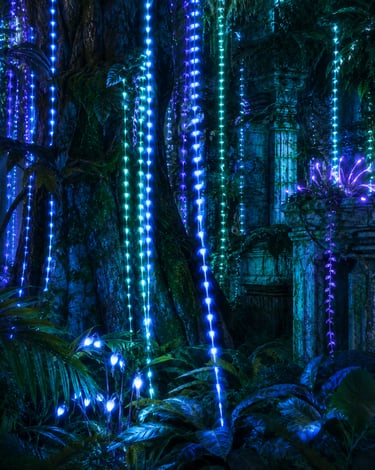
Valanar plants were a class of bioluminescent flora native to Milonia, with rare, sporadic growths in Ionia. They produced natural light in countless hues and shades, and had shaped certain cultures, such as Masorania, who lived partly in the nightworld. Elsewhere on Antoria, however, the plants were little more than a curiosity, if not outright legend.
The Yonians brought specimens with them during the Revolutionary War, and during Pax Yanakhon the lamp-plants became both a valuable commodity and a cultural phenomenon, particularly in the larger cities. They offered a steady, reliable light without the dangers or filth of flame: no smoke, no foul-smelling oils, no soot-blackened glass or walls.
Valorine
Valanar liquor was a concentrated extract derived from the essence of the bioluminescent plants. Through a particular refining process involving wood ash or slaked lime, the liquid could be dried into a stable powder. When later mixed with an acidic substance, most commonly sour fruit juice, the dormant essence reactivated and emitted a relatively intense glow.
The powdered extract could be stored indefinitely without losing potency. It was often packed into small vials or cartridges and paired with flasks containing prepared acidic liquid, sealed with wax stoppers. With a single press or break of the seal, the two substances would mix and create a lantern-like burst of light. The initial flare was strikingly bright before gradually dimming over the course of few hours.
Hair Bleaching
Mashed and soaked, valanar plants could be evaporated into a potent liquor capable of bleaching hair and fabric alike. The practice carried deep traditions in certain Milonic cultures, though it was the Ikharonians who became by far the people most associated with it, favoring every variation of the substance and its use. Because of this, they earned the nickname Whitlings among foreigners, or Tharkhum, “pale-folk” in Silvon.





Yonian artificers later expanded upon the design, developing spotlight lamps that used dual-valve flasks to replenish the spent liquor in measured amounts, allowing the glow to be sustained for far longer periods.