

Torpack Concrete
Torpack (tor + pakh = castle + mass, bulk, stuff) or Ikharonian concrete was pretty much as we know pozzolana concrete. Could be embedded with windsilk to increase toughness.
About Yonian Metallurgy and Brimbronze
The Ionian continent's mountain ranges possessed rich deposits of both copper and tin, making bronze far more available there than in many other parts of Antoria. The Selerian Empire discovered the tin mine of Khalithron deep in the southern wastes early: this discovery made bronze readily available, and the Selerian foundries perfected smelting, alloying, mold-making, and large-scale casting at an early stage.
Through generations of experiment, Selerian founders discovered that adding carefully measured quantities of brimmboric metal to tin bronze improved the alloy’s strength, toughness, and resistance to wear. This material came to be known as brimbronze. It was superior to early iron and remained one of the signature materials of Yonian engineering, and in farlands, gained the nickname yanabronze. Its exact manufacturing process was considered a state secret at one point.
Later advances in steelmaking eventually displaced brimbronze in weapons and cutting tools. Properly forged and hardened steel made better blades, spearheads, axes, chisels, files, springs, chains, and armor-piercing points.
But steel could not match bronze’s greatest industrial advantage: its castability.
Where steel required difficult smelting and processing of the ore, careful control of carbon, repeated forging, and skilled hand-finishing, making it very labor-intensive, brimbronze could be cast into complex, near-final shapes with remarkable consistency. This made it ideal for mass-produced equipment, especially parts that needed durability, precision, corrosion resistance, or decorative detail.
For this reason, a great portion of Yonian equipment continued to be made from brimbronze even in later steel-using eras. No one on Antoria could not match the Yonians' ability to mass produce equipment. Blades and major force-bearing components were steel, but helmets, buckles, hinges, bosses, pulleys, ratchets, fittings, seal presses, armor mounts, ship hardware, machine housings, and official instruments were often cast in brimbronze.


Milleries were proto-industrial complexes built around cascades of watermills that powered a wide variety of tools from saws to grinding wheels to power hammers, bellows, lathes, boring and drilling tools, etc. A millery could be established around a natural water source, or one could be built elsewhere using aqueducts.
Brimmboric steel
Brimmboric steel - another meteoritic alloy only occurring in two known locations in the Iron Mountains: Grimrock and Ramrock mines, and processing it was a secret of the Renkeranck Iron Guild.
Resistant to rust, it retained high toughness when hardened; could be tempered harder than common steels. Was used to craft high grade equipment, but curiously also used to make money, krammers, whose authenticity was confirmed with two files, an ordinary one that did not bite, and another one made from yet another alloy, valcamic steel.
The Condarian Seafarers' Empire was built with this steel, and it remained as one of the best materials for making excellent armor and weapons.
Duran - the Sarcophagus Steel
Duran is a rare meteoritic alloy-steel produced only in the Hidden Valley of Harachim. It is famed for its air-hardening behavior, resistance to rust, excellent hot strength, and its naturally forming wavy oxidation patterns, which shimmer in bands of blue, gray, violet, and black when properly polished.
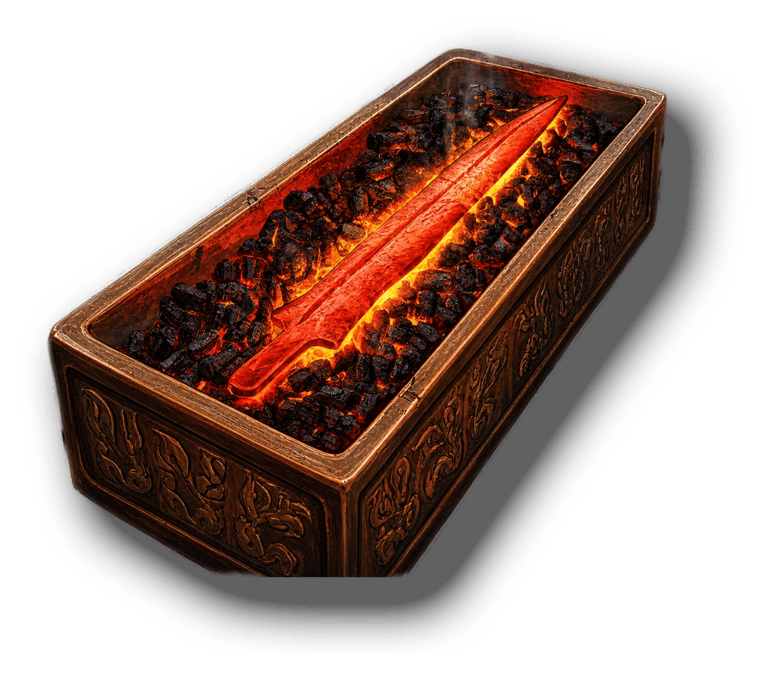
The metal got its name from the Silannic root durchanat, meaning casket, sarcophagus. The name came from the need to rest half-worked duran billets in sealed, coal-filled boxes during forging, because the metal is air-hardening. Without these annealing rests, the steel was prone to crumbling, cracking, or splitting under the hammer. The Hagachim method required three overnight rests before a raw lump could be reliably drawn into a blade.
Duran made superior blades, armor, and tools for hot work. Its special importance came later, when the Hagat Belait, the Durachim's Lightning Warriors, discovered its unique suitability for thunderblades. Where ordinary steels noodled under thunderfire's heat, duran retained its form to golden-white heat, and being air-hardening, recovered its hardness after glowing hot.
Valcamic Hardmetal
Valcamic hardmetal was extremely hard and unusually heavy, over twice as dense as steel. It was impossible to melt with known technology, but could be added to iron to make unusually hard, but also brittle alloys.
It was mostly used for making tools, cutters, stonework bits, armor-piercing bolt heads, weights, etc. It was very rare and expensive, but tools made out of it allowed highly efficient steelworking in form of chisels, files, saws, etc. and was also used as mining pick and drill heads to cut through granite.
Name hailed from Strömic word välkam, meaning hard stuff. All of this metal originated from the depths of the Grand Mountains, a monopoly controlled by the Vaskites.
Windsilk
Windsilk or Ikhanic vine were long vines native to Ikharonia and Khaimeranic regions in the south. The processed fibers were incredibly strong. Was used to make common ropes, bowstrings, and armor. During later eras, tech was developed to allow it to be used for crafting skyship canvases, reducing their cost, albeit being heavier than whitesteel.
Anduran Spider Silk
Anduran (andal duran - white armor - dubbed as whitesteel) or spider silk. Existed only in a few known colonies of lapdog-sized spiders, its harvesting was difficult, as was its processing, but it was one of the lightest and strongest materials known. It was used in a few historical occasions to enhance armor as common blades had difficulties piercing even a single layer, however the difficulty of harvesting it made it ludicrously expensive and rare, so it never saw real practical use - not before it did.
Its lightness and resistance to prolonged heating made it ideal for the most unexpected use, skyship canvases and sails. Nobody but Professor Gilgavangel was mad enough to even think about it, and no one but Vice Merial Arhim was commanding enough resources to harvest and process it. The Yonian States' civil war drove them to farm these creatures to mass produce anduran for the arms race. Windsilk substituted it later where possible, but it degraded under heat and had to be replaced eventually.
Papers
Limpur ("pressed wool") or wood pulp paper - originally invented by the Ikharonians, it eventually replaced the Palpurian cartoph, a straw papyrus. It was, of course, weaponized too, by making armor.
Folded blocks were sewn together and treated in various ways, including dunking in tar to make them water resistant. This allowed making armor that was lighter, warm in cold yet cool in hot, and offered better protection especially from piercing attacks like arrows.
Above all, it was much cheaper to manufacture in mass quantities, allowing the Yonians to equip their army with scarce metal resources during the Revolutionary War. The armor design was perfected during Pax Yanakhon, and became the standard issue for Yonian legionaries. Due to paper's properties, it could even stop bolts of thunderfire that burn readily through steel.
Woods
Javanawood was tough, suitable for bows and items needing strength, but too rare and expensive for building larger things. The trees were short but thick, with heavy ball-shaped leafy top full of branches.
Ironbanck Oak or Ironwood is a dark, dense, slow-growing maritime hardwood from Ironland and the Continentals, famed for its strength, durability, and resistance to rot. It was one of the key materials that allowed the early Condar seafarers to build robust blue-water ships. The Selerian Empire and later, the Yonian States imported it in large quantities for building their navies; ironwood was the material of choice for ships' keels and critical structural parts. Measuring as one of the strongest woods known, it was also the heaviest and difficult to work due to its hardness; it was naturally oily, and resisted rot, pests, and saltwater.
Sharpawood was native to Ikharonia and Teleng region. It was pale, and one of the lightest woods, but very tough and strong, making it suitable for many applications. Ikharonians crafted most everything from it, from bows to canal boats, and it had a grain structure that aged well, making it a good contrast wood for darker woods in furniture crafting. The most famous use of sharpawood were the hulls and structures of skyships.
Yaliwood was a lowland wood requiring rich soil and plenty of water, and was relatively soft and unsuitable for any demanding applications. It grew shallow, reminding jagolinewood. It produced yaliflowers annually, its leaves being its most distinctive feature: they grew in shades of purple, and could be used to produce purple dyes in all shades with a proper extraction method. Its flowers had white petals, and its golden berries were used as food.
Jagolinewood was abundant in the coastal regions and on Jalipan islands. Mostly known of the jagolines it produced, the wood itself was used for crafting furniture and small items, including staffs.
Kibrat Crookwood was, unlike the name suggests, commonly perfectly straight, small tree, with crooked branches at the top reminding its roots. These trees survived in the driest of wastes and were abundant in the Southern regions. Harachimians used them to craft battlestaffs, and their dried and ground roots were used as spice.
Treasurewood or Dalatolk was a rare type of tree native to Harachim Valley. It was the only known host for the treasurebread fungi. It grew exceedingly slowly and could take a century to reach full height; its trunk reminded a huge stack of gnarled, twisted ropes, and its top was sparse basket of branches, its leaves almost round. Harachimians cherished these trees as the most valuable thing in their realm, and they were never known to be used for building anything.
Caporic wood was dark, dense wood, most often used in furniture making. It paired well with pale sharpawood.
Arniwood was native to Pelonnia. It was close to fir, but harder, and above all, abundant beyond measure, for its growth covered most of the continent.
Untowood or Ektohong or The Millennium Tree was a very unique type of wood growing only in the Lonely Valley of Ikharonia. It took thousands of years to reach full size. Single woods could span as far as a mile away from the mother trunk, both above and below ground. Its wood was very dense, hard, and dark, and the mother trunks could reach three hundred feet in both diameter and height. The petrified heartwood, or the essence of Ektohong had a very special role in the old Ikharonic culture, and though it was seldom accessible, a single dead tree's essence could be enough for entire civilization for many generations.