
Some Antoric creatures are presented here.
Creatures
Baggat, known in Silvonian as pakhat, was a sturdy, goat-like beast native to the Highlands and mountainous regions of Ionia. It possessed a thick coat of coarse gray or dark brown hair that grew in stiff, uneven tufts well suited to cold winds and sleet.
A full-grown baggat stood roughly one to one and a third meters at the shoulder and commonly weighed between two hundred fifty and four hundred kilograms. Its most striking feature was its massive horns. The creatures communicated through a rough vocabulary of huffs, snorts, groans, bleating, and low murmuring sounds.
Adapted to steep and broken terrain, baggats were invaluable draft animals throughout the Highlands. Though slower than horses, they possessed tremendous strength and could haul loads equal to two horses while traversing slopes and rocky paths where ordinary mounts would stumble or perish. Their muscular legs also allowed them to launch sudden, fast charges over short distances.
Baggats were ruminants with broad diets. They consumed nearly any plant matter they encountered: hay, moss, bark, roots, mushrooms, vegetables, fruits, and tough mountain scrub that most livestock refused to touch.
Wild baggats were shy by nature but notoriously aggressive and dangerous due to their strength and horns when cornered or threatened. However, if taken young, they could be domesticated with great success. Males posed the greatest difficulty, as they were intensely territorial and prone to brutal fighting. Highlanders often separated mature males or castrated them to make them manageable. Domesticated baggats typically had their horns cut back or fitted with blunt wooden caps to prevent accidental goreings, though some steadholders deliberately left the horns intact when using the animals as guards.
Yonians preferred baggats over horses for many forms of labor. They endured cold, hunger, altitude, and rough terrain while surviving with little, and also provided valuable by-products: milk, wool, meat, hides, and horn. Baggat wool was used in the making of coarse but durable and warm clothing, blankets, and rope. A healthy baggat commonly lived between fifteen and twenty years.
Baggats


Selkhin striders were a wandering horse breed native to Seleng and the wider Arhanic plains. The breed had adapted to covering vast distances across open steppe and wind-scoured grasslands, developing into some of the finest endurance mounts in the known world.
The striders possessed lean frames, narrow chests, and long legs built for sustained speed. Their gait was unusual: they ran with slower rhythms, striding over the plains in long, effortless bounds that gave rise to their name. Well-kept striders with light riders could cover two hundred kilometers in a single day, and the greatest recorded mounts were said to have crossed three hundred.
Selkhin striders
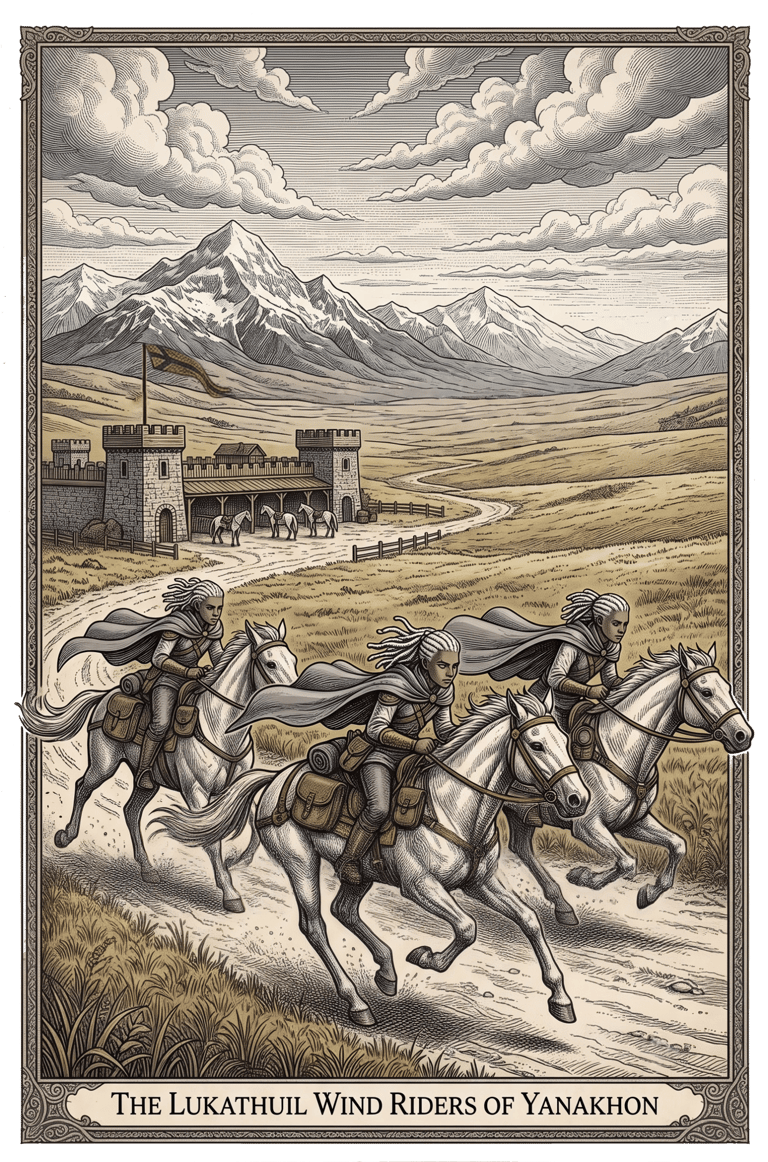
Golthangs, more commonly known as goliath bulls, were immense ruminants native to the great Continental pastures. Following the Seafall, sizable herds were established across the Midland plains of Ionia after Selerian seafarers from the Ranckport Colony brought calves from Rammornia with them. The animals adapted remarkably well to the open grasslands, and within generations, herds the size of thousands of beings had spread across vast stretches of pasture.
The goliath bull was the largest known ruminant on Antoria. Mature bulls commonly weighed between three and four tons and could stand nearly three meters at the shoulder. Their bodies were mountainous masses of muscle and bone, supported by thick pillar-like legs and crowned with large, tapered, forward-curving horns.
Because of their sheer size and mass, goliath bulls possessed few natural threats. A charging bull could trample or gore even the greatest predators foolish enough to test it, and the animals rarely traveled alone. Entire herds wandered the endless grasslands in slow migrations that could darken the horizon with moving bodies and clouds of dust. Only saginairs were known to have reliably hunted them.
Attempts to domesticate the beasts met with little success. Though calves could be raised by hand, mature bulls remained unpredictable and violently strong. In the rare instances they were employed as draft animals, the creatures eventually bolted more often than not, leaving shattered carts, ruined buildings, and dead handlers in their wake.
Across the northeastern Mainland, an entire cattle economy developed around managing the herds and protecting the mallang fields from them. Even so, the bulls provided ample quantities of beef for the herder communities that followed and culled the roaming herds.
Golthang - the goliath bull


Hurchons, or dunephants as they were sometimes called abroad, were great shaggy herd-beasts native to the deserts of southern Mainland. Populations also roamed the Morakhon regions farther south. Despite their immense size, hurchons were known as remarkably passive creatures, and surviving accounts contained almost no mention of aggressive behavior toward humans.
The animals wandered the deserts in loose herds, crossing dunes and dry basins in slow migrations that could continue for hundreds of kilometers. Their thick coats protected them against the cold desert nights and abrasive sand-laden winds. Hurchons had been domesticated in various forms since the earliest times and were used for hauling, caravan work, and the transport of heavy goods across the deep desert routes.
Wild hurchons possessed a curious but timid disposition. Travelers often reported seeing entire herds trailing desert caravans from afar for days at a time, watching the movement of people and animals across the sands while carefully maintaining their distance. Only rarely would a wild hurch approach close enough for direct contact, and even then the creatures usually retreated at the slightest disturbance.
Among desert peoples, the sight of distant hurchons shadowing a caravan was considered a good omen, a sign that the route ahead remained safe and that water could not be impossibly far away.
Hurchons - the Dunephants


Ancient creatures or Ancient beasts are a group of Antoric beings that are unusual, rare or mythical in nature. Several unnamed and uncharted species and subspecies exist.
Ancient Creatures
Saginairs
Saginairs are great winged felines native to the high mountain ranges of Yanakhon, with related subspecies found in the southern ranges of Northern Naxoria and Kallihalissor. They were often referred to as the Lords of the Mountains Impassable, and were known to descend to the lowlands only to prey. Seldom few were ever able to see one close, with usual sights high in the sky, difficult to distinguish from birds.
Resembling snow leopards in form but built for altitude, they are leaner, longer-limbed, and far more aerodynamic than any land-bound cat. Adults grow larger than the greatest horses, with wingspans reaching up to fifty feet.
Their bodies are covered in thick, velvety fur suited to the cold, thin air of the high peaks, commonly in silvery tracery stripes running across their bodies like the grain of folded steel. Their wings consist of leather membranes covered in thin, dense, velvety fur, and they have a long tail for balancing with a leather membrane fin tip for maneuvering.
Despite their fearsome nature, saginairs are not wantonly aggressive. They are intelligent, proud, and intensely curious creatures. Encounters with humans are rare, and attacks rarer still, typically occurring only when provoked or challenged. They were regarded as mythical, deitic creatures living high in the mountains, only descending to lowlands to prey. Saginairs were known to utilize the winds of the skies to cross long distances over the mountains.
In Yonian culture, saginairs have held deep symbolic significance since the dawn of time, where they were regarded as near-divine beings. For most of history they were revered and left undisturbed. During the Selerian Golden Age, they were hunted in earnest, however only Knight Taranthurm was known to ever have fallen one.
The Birth of Saginair Rangers
Many sought to reach or claim these creatures, but it was Gralon who first succeeded by taming an injured beast during his mountain exile. This was the first known bond with a saginair, and by earning the pride's trust, Gralon was able to tame more beasts for his warriors. Thus was born the Rangers of Yanakhon. Go to the main article.


Wildbirds (Arn. Arnicraw)
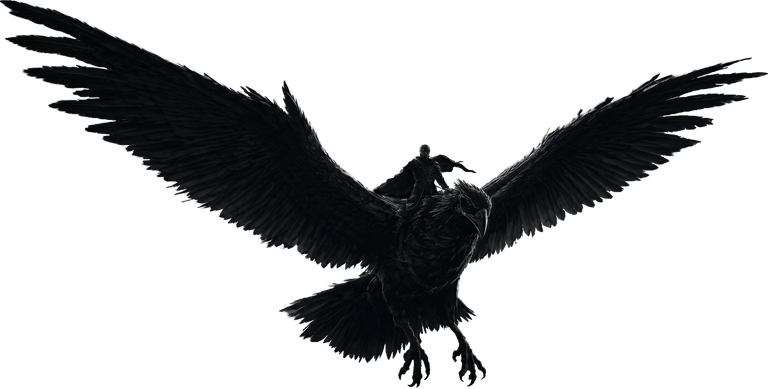
Wildbirds were a group of gigantic birds akin to crow, eagle and other raptors. The wingspan could exceed 50 feet, and their feathers were commonly black, sometimes with gray, seldom with white details. Also known as Arnibirds, they were able to fly high and cover the entire Pelonnic continent.
They mostly lived in the vicinity of mountains and were present in every corner of Pelonnic continent, but were known to avoid the Grand Mountains due to the presence of their own beasts, vaskyrs and the grand dragons; and they were also an uncommon sight in Hellornia and the Draconic Mountains due to leathereans and their native dragons.
They were a part of the Arkadic high culture in Arnioric lands and Phanim, and the Arns that used to ride these beasts were called Arkhen Gliders. These glider guilds at their peak era used to equip and train the beasts by arming them with steel claws and beak pikes, making them highly capable in combat.
Only way to tame and bond with these beasts was to grow them from a hatchling.
Their eggs were exceedingly rare and valuable, and were considered the highest order of gift in the Arnioric cultures. The beasts avoided people and like many other high rise creatures, and only descended to lowlands to prey. While respected, they were also hated as they constantly taxed cattle, and although rare, they also preyed on humanoid races.
Howlerines (Huraks)
Howlerines, known as Huraks in Busdravic (Hurcuz), are apex predators native to the Wilds of the Norths in Pelonnia. They resembled a mix of wolf and a bear, and various species were known, ranging from the size of a lapdog to a big horse. Pelonnic tribes mastered taming these creatures, using them as effective fighting beasts.
In Silvon, the term hurak refers to the great howlerine beasts, but a simple hur is used for the small tamed dog breeds.
Beasts of Pelonnia
Beasts of the Northern Continent
Leathereans (qhuliqhul)
Leathereans or shadedrakes were described as a grotesque fusion of a lizard and a bat, a bit like pterodactyl, flying dinosaurs. they lived in the shadows, were able to move without sound, and did not discriminate their prey, eating humans and animals alike and were known to prefer eating brains of other creatures.
They had a plethora of vocabulary, from vicious shrieks and long-winded eerie howls to ominous clicking, rattling and snapping, hissing and growling. they had sharp teeth in the long beak, and strong hind legs and large, fluttering leather wings.
They were able to cling to surfaces like a spider. it had big, nocturnal black eyes. Leathereans were nocturnal creatures that were described as a mixture of a lizard and a bat. They were native to the Draconic peninsula, with several species ranging from small house bats to the most feared species, the qhuliqhul, or nightshade in Sparkor language.
Vaskyrs
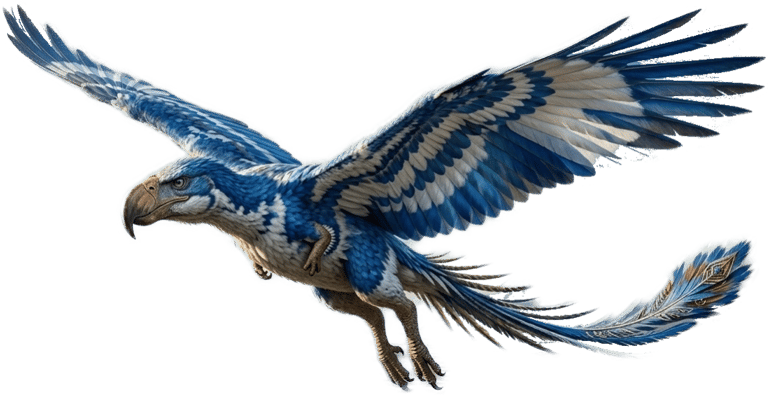
Also known as stormbirds, vaskyrs were ancient bird-like beings, with distinctive shrunken frontal limbs which they used to grab onto the rocky cliffs of the Grand Mountains, their native inhabitant. They had strong hind legs with large claws. They had large, smooth beaks which were robust enough so the creatures could pick and maul their prey. The creatures could clatter their beaks, making distinctive clacking, rattling sound that could be heard for miles. Other than that, they had wide vocabulary, ranging from long, high-pitch calls to soft cooing to a piercing screech.
They were covered in thick feathers usually in shades of blue, and their wingspan could reach 70 feet. Vaskyrs natively habited the fjords of the Grand Mountains, and were only seldom seen elsewhere. In the north, the arkhenbeasts tended to keep their own territory in watch, vaskyrs seldom crossing the Arnivangel pass and valley.
To the west, they sometimes habited the Murmannic Mountains and even as far south as Arkhanic Mountains. They natively also habited the Iron Mountains. Vaskyrs were raptors with wide appetite, but they were not known to prey on humans.
They were generally regarded non-aggressive, but they protected their nests and territories fiercely. Vaskites were able to tame the creatures for their own needs by seizing their eggs and growing the creatures from the hatchling.
Dragons
Hellornian Dragons
(Sil. Rasa-khul [Ras - fire; khul - demon] or Hell. Zpar'kon [Zparc - fire, ignition; kon - being])
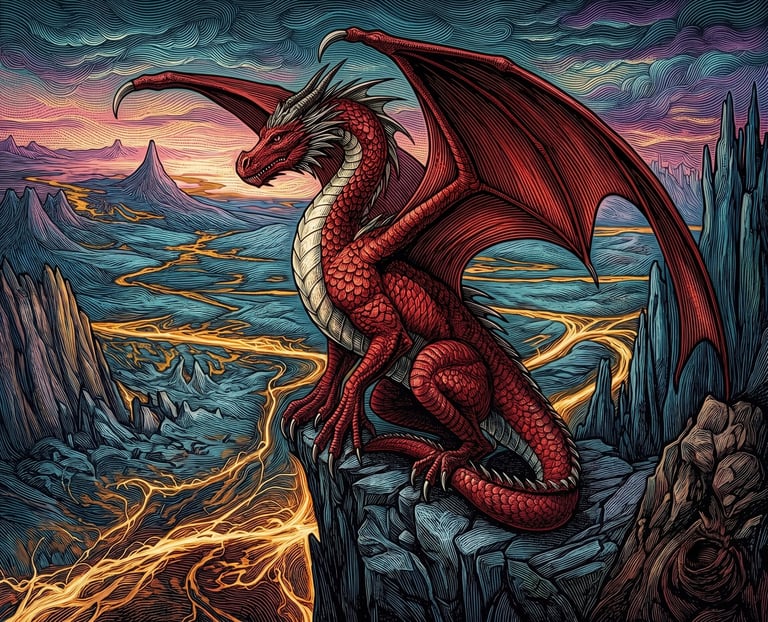
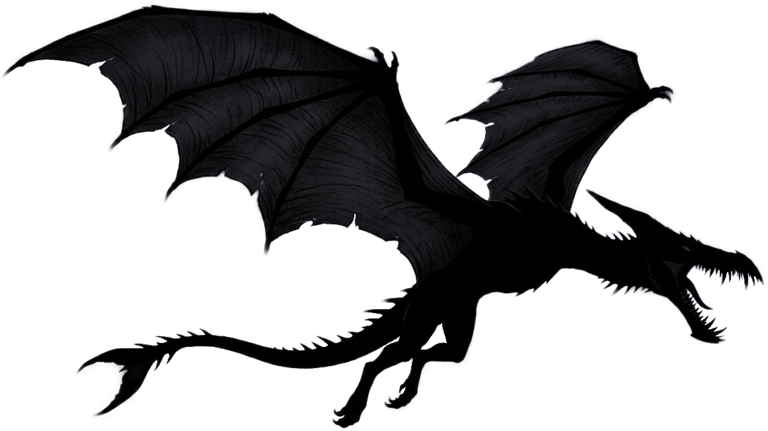
Probably the most known race of Antoric dragons, the Far West's Hellornian dragons were the only species with fire-breathing ability. They lived in the Hellmoric and Drakomoric mountain ranges and volcanic plateaus, descending to lowlands to prey. Their wingspan routinely reached 100 feet or more.
The dragons consumed sulphur to induce the fire-breating capability, but they natively used this only in mating rituals. The dragons could exhibit any colors, but red, black, and yellow were the dominant colors.
To Hellornians, these dragons were for long a bane of their existence, with the beasts routinely descending to the lowlands to prey for them and their lifestock. Dragons were hunted and killed every chance they got, with very little success. Raids to their nesting sites up in the Mount Dom Nuriaz were carried out by the bravest.
It was after a failed dragonraid, which young Sparkoniz survived alone, he held to an egg, which hatched to him, and he was able to bond with the beast, and through it, face the rest of the herd and earn their respect. This turned the tide, with Sparkoniz conquering the entire realm.
He formed the Hellornic Dragonrider Empire by introducing volunteers to the beasts, which either bonded or incinerated the candidates. For reasons unknown, the dragons seemed to favor left-handed warriors, which quickly gained cult status in Hellornia, giving rise to the name of the Dragonriders of Elite Argom.
With the newfound power, Hellornians sacked the Causuck Coast and Pelonvangel pass city, Faireanic lands, and the Balbour City, and also made several raids to Gui, Land of Raman, and Arnioric heartlands and as far as Shambor, Colossia and Phanim.
Grand Dragons, Sil. Storm-khul or Str. Störmrök
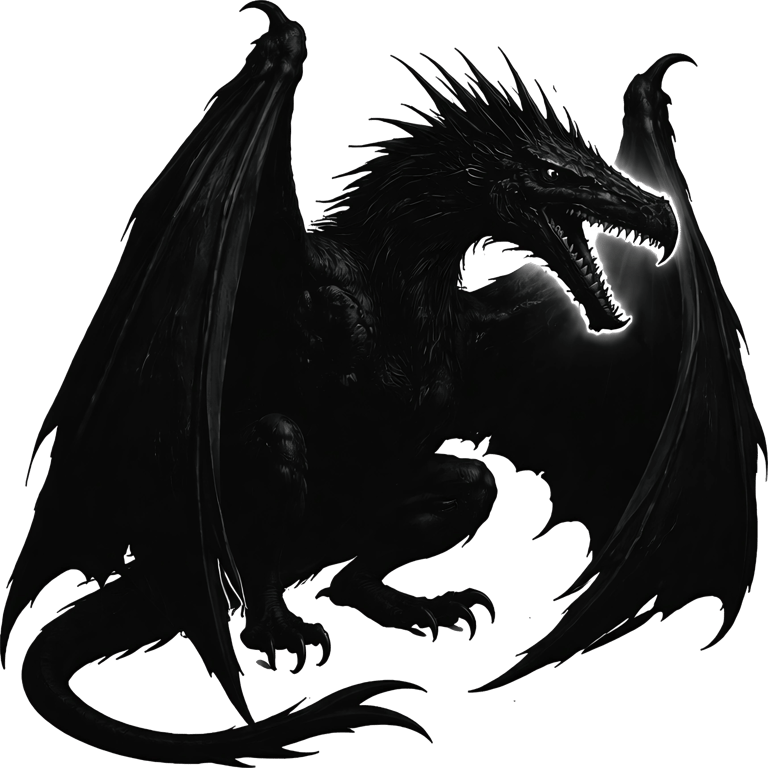
Grand Dragons or Stormic Dragons were the other major dragon species on Antoria. They were a secluded species native only to the Grand Mountains, and in there, primarily residing in the heart of Grand Glaciers. These dragons mostly fed on sealife, being able to dive deep into the depths of the Stormic fjords, catching everything from fish to whales. They seldom ever left the Grand Mountains.
While Grand Dragons did not breathe fire, they grew vastly larger than their Hellornian counterparts, having average wingspans of over 300 feet. The sheer size of these creatures made them virtually impervious to any other creatures on Antoria, and perhaps lack of any natural threats, they were considered rather tame and peaceful creatures. The scales could reach thickness of 4 inches. The creatures had been observed exhibiting shades of blue, white, with unique instances of other colors.
Vaskites demonstrated the capabilities of these creatures during their high era. While incapable of breathing fire, the creatures were simply large enough to stomp over most of their enemies, including the Hellornic dragons, which was the only force that was able to resist - and ended up being the downfall - of Sparkoniz's Dragonrider order.
The fire-breathers had little to no effect on these grand beasts, but meanwhile they could seize those smaller beasts and bite off their heads with a single bite, or simply crush them. In most instances, the mere introduction of a Stormic dragon was enough to make the enemies surrender, and the Vaskites used this to mostly peacefully enlarge their empire across the Colossian coasts, Ironland and the Continental lands, Phanim, Perillenia - and Yanakhon.
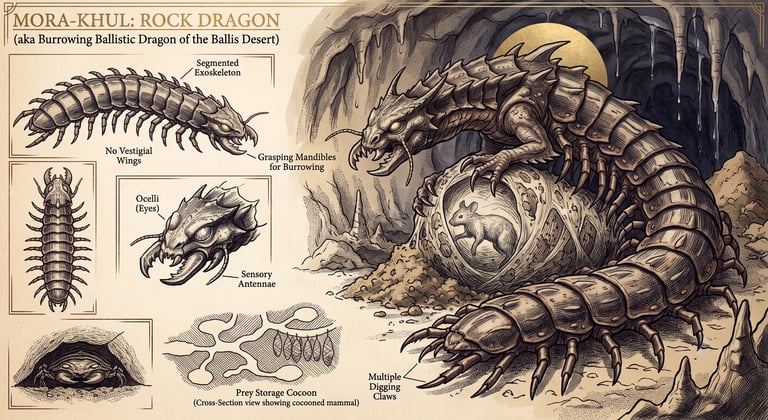
Rock dragons, Mora-khul or Mardauk
Also known as Burrowing Ballistic dragons of the Ballis Desert, they are wingless and live underground in both natural caves and tunnels they excel at burrowing.
Deep dragons, Haub-khul
This is the least known race of the dragon legend, and many believe them to be a mere myth. Living in the vast Antoric Ocean and the Windsea, they mostly stick to the depths.
Dragons are considered one of the major classes ancient creatures, amongst saginairs, vaskyrs, leathereans, and wildbirds. In the Yonian world, dragons were widely regarded as legends of the far reaches of Antoria, few believing they even exist, and being only part of the Tale of the Three Kings. In the Yonian States Revolutionary War, they were proven to be very much a real thing.